Resources

This section contains articles and topics of interest to those meeting the challenge of improving performance in Manufacturing and Process Industries.
That includes guidance to site resources on the topics of Taming Technology, Ratcheting Up Performance, Delivering Better Projects Faster and Digital CI.

The Art and Science of Project Management
- Details
- Category: Resources
The articles below explain the Art and Science of Effective Project Management. Traditional project management focusses on the logic/science alone but both are needed to deliver better projects faster.
Click on the left hand tabs for examples of common project management pitfalls and how to avoid them. Logic alone is not enough
-
Project Management Disasters
Project management disasters are not new. but what can we learn from them?
As early as 1628 when the technologically advanced Swedish Flagship Vasa’s sank on its first sailing killing about 50 sailors. A catalogue of design modifications during building meant that the standard test of stability (30 sailors running from side to side to rock the boat) was cancelled because it showed the vessel to be unstable. More recent projects that have suffered similarly include the Mars Climate orbiter (1998) that got lost in space because different parts of the project used imperial measures and another metric measurement. In 2015 SNCF, the French railway company spent $15bn on a new fleet of trains that were too large for the stations they were supposed to service. It turns out that the trains are also too tall to fit through some of the tunnels in the French alps.
Ultimately these failures are due to weaknesses in one or both parts of the project journey i.e.:
- Part 1: Developing the right specification (80% Project Management Art, 20% Project Management Science)
- Part 2: Delivering that specification. (50% Project Management Art, 50% Project Management Science)
The above failures point to weaknesses in part 1. A journey characterised by uncertainty, the need to collate knowledge, gain insight, engage stakeholders and work with them to make smart choices.
Some traditional project management methods such as Prince2 (Project in Controlled Environments) specifically excludes the Project Management Art of knowledge/creative management, project quality assurance mechanisms and value engineering processes that characterise over 50% of the building blocks of Project Management Success.
Get both parts of the journey right and the gains can be significant. An oil and gas extraction company investing in a floating platform to extract oil and gas from under the Atlantic estimated that the additional output produced by achieving their goal of “flawless operation from day one” was enough to recoup the total capital investment costs in the first year of operation.
Organisations that do this well use a blend the project management Art and Science to avoid common project pitfalls.
 Pitfall 1: The Project Scope
Those that don't understand their history are doomed to repeat the mistakes of the past.
The Art of Project Management
Capital projects fit the definition of what has become known as a wicked problem. That is a problem with many potentially conflicting design goals.
At the start of a project, it is important to spend time defining the outcome needed rather than jumping to a solution too early. We may think that we know what is needed but to use a military term, time spent on reconnaissance is seldom wasted.
After committing to an additional spend of £10m on new assets a major supplier to the aerospace industry identified that the additional capacity it needed could have been achieved by spending less than £100k on actions to deal with design weaknesses and improvements to the condition and maintenance of existing plant.
A similar assessment at a soft drinks bottling plant identified the opportunity to avoid capital investment of around £5m.
In both cases, the trigger for the original investment brief was traced back to a knee-jerk investment decision made in haste in response to a shift in market demand.
The Science of Project Management
As any experienced designer will explain, the starting point to unpick such complex problems is to gain an insight into the day to day reality of the current user. Then identify what is it that helps and hinders their efforts to deliver the desired outcome.
The table below sets out 4 techniques to support this assessment.
 Pitfall 2: Project Expectations
Managing cost rather than project value
The Art of Setting Project Expectations
Behavioural research shows that when faced with a choice between options that we have no previous experience of, under pressure our unconscious mind will make a decision by answering a similar but different question. For example, some might select equipment based on purchase price rather than the total value to the organisation. Low capital cost can result in later operational problems which cost more in the long run. The pitfall here is to assume that the specification can be defined in detail at the start of a project.
In reality, every initial project specification is a work in progress. Even specifications for similar projects will differ due to the unique circumstances of different sites and the desire to apply improvements due to lessons learned. Be clear about what decisions need to be taken at each step of the capital project journey and make only those that are necessary to progress to the next milestone. At concept step, we need to select the right type of solution (get the right design) at the high-level design we work with a vendor(s) to get the design right. That is where the detailed plan is defined. The delivery steps will add further detail to how the organisation can deliver the full potential of that solution
Once the desired outcome has been defined (See pitfall 1) set out a stepwise milestone plan with clear expectations for each milestone. Add detail to the path between each milestone as more is learned about the options and a preferred solution is revealed.
Milestone plans include the definition of criteria to confirm that the desired outcome has been achieved before progressing to the next step.
For example, do we have buy-in from all stakeholders to the High-Level Design specification which will be used to develop the ITT (Invitation to Tender) document?
Once past the stage gate, we can then circulate it with confidence. These milestone exit criteria provide project quality assurance framework.
The use of milestone plans provides a framework for project governance to manage the iterative, evolutionary linkages between the people, procedural and process related development activities of part 1 of the project journey.
The Science of Setting Project Expectations
Use Milestone plans to set out the signposts of the project journey.
Start with a preferred concept based on an evaluation of at least 3 options. Add detail to that to create a high-level design which makes clear the benefits sought and the cost justification. Use this to explore what vendors have to offer and what they can provide. Work with the vendor to develop a realistic and achievable project quality plan to:
- Support the identification of skills and resource levels for each supporting activity/task;
- Allow detailed planning to be left as late as possible;
- Simplify progress measurement and reporting;
- Confirm progress.
- Support the milestone planning activity with:
Activity schedules which define what has to be achieved to progress to the next milestone;
- Tasks which set out how the activities will be completed. These are also used to identify skills and resources levels;
- Briefing notes set out guidelines for the aims, approach, and outputs for activities /tasks.
These are techniques are covered as part of the Manufacturing Project Management and Early Equipment Management Courses.
 Pitfall 3: The Project Team Culture
The Art of Project Management
The success of a project depends as much on the project team culture and the teams working relationships with the rest of the organisation as it does on their knowhow. A project manager needs to be able to facilitate this network interaction to deliver the full project potential. Part leader, part teacher and in some cases part social worker.
The Science of Project Management
The process of how team members are inducted to the project has a major impact on the speed and level of their engagement with project goals. The behavioural signposts that mark the steps of this transition are
1.Team member able to understand the task and visualise what needs to be done
2.Team member makes plans to achieve the task
3.Team member implements those plansThe progression from signpost 1 to signpost 2 above, is an important transition. It is not unusual for team members to wait for tasks to be allocated and then later complain that they had nothing to do. Their ability and willingness to make the transition will be influenced by the culture within the project site. Particularly for front line personnel involved in projects for the first time, they need help to move from a directive, defined production environment to one of uncertainty and discovery.
To accelerate this progression, give new team members the opportunity to develop plans or define their role in the team from an outline brief. Once their plan has been developed they have made the behavioral transition from step 1 to 2 above. This sets the foundations of the psychological contract between the team member and the project manager. The project management role is then to help refine the plan and support the delivery of it.
Get the team engagement right and the project management role is transformed from one of policing to one of project leadership. A much more effective and rewarding approach.
Pitfall 4: More Haste, Less SpeedThe Art of Project Management
During the normal day to day routine, the direction of information flow is downwards. Those involved in a day to day shop floor reality are the ones who can make or break investment performance. That means opening up channels of upward communication. This includes allowing time and space for reflection for managers and their direct reports on challenges faced, options selected and plans made. Without this outlook, project teams may be working on the wrong tasks or ignoring the areas which are outside of their comfort zone.
The Science of Project Management
The cross functional core team members work best when they provide a communications conduit between the project and the rest of the organisation.
Project war rooms are a great place to do this. Here key project information is visible and the links between issues can me more easily considered. Toyota considers Oobeya (Japanese for big room/project war room) to be the backbone of the Toyota Management System. This is where the project sponsors and project teams meet to carry out develop briefs, carry out design reviews, review progress and agree on actions. Just like in a CSI investigation, a place to look for connections and solve puzzles.
Project Governance benefits of Project War Rooms include:
- Better visibility and engagement
- Improved communication, visibility of plans and workload
- Improved engagement of leaders and teams
- Ease of priority setting
- Greater accountability
- Focussed targets drive team activity and proactive behaviour
- Clarity of metrics and alignment of commercial, operations and technology team goals
- Increase team awareness of parallel work streams
- Better cross functional collaboration
- Quicker problem solving
- Everything to hand
- Problems made visible and shared
- Creates the conditions for innovation and new thinking.
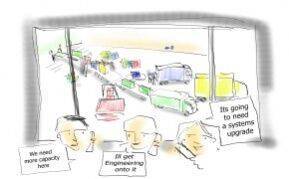


How to Develop Your Project Governance Skills
- Details
- Category: Resources
The tables below set out learning plans for project stakeholders including users who are impacted by the project delivery, Project Sponsors and Project steering team members.
The first table covers training topics to develop a common language and shared understanding of the project management process. In addition setting an agenda for discussion about what to do when, progress through this learning plan also guides the identification of gaps in underpinning systems and processes so that they can be refined to secure the achievement of flawless operation from day 1.
How to Develop Your Project Leader Skills
- Details
- Category: Resources
The tables below set out learning plans for project leaders and project team members. Contact us if you would like details of in house training or coaching support programmes in any of these areas. A guide to further project management resources can be found in our article on delivering better projects faster.
The first table covers training topics to develop capabilities to coordinate manufacturing projects from concept through to beneficial operation. That includes the development of both personal project management and project team capabilities. This is an important leadership role as typically more than 50% of project team members will not have formal project management training. Hence the title of Project Leader rather than the more traditional Project Manager.

Designing Equipment for Ease of Use and Maintenance.
- Details
- Category: Resources
An analysis of over 500 man years of asset run time indicates that Human Error is a contributor to around 50% of equipment problems and effectiveness losses.
Add to that another 35% of failures due to difficulties in access and inspection and the evidence shows that over 80% of reliability issues can be eliminated during the equipment specification and design stages. The gains include increased return on investment due to:

Life Cycle Cost Analysis a Guide for Engineers
- Details
- Category: Resources
Life Cycle Costing, combining capital and multi year operating costs into a holistic measure of cash flow, is well known but it is often seen as a complex, difficult to apply financial analysis tool. Yet in most cases, a simple LCC model, taking under an hour to complete, will be sufficient to widen the basis of decision making leading to improved performance of both current and future assets.
This article explains how Life Cycle Cost principles can be applied in a simple but practical way to guide decision making about how to:
- Deliver the full potential of current/legacy assets;
- Make informed decisions that reduce Life Cycle Costs even when individual asset cost data are not available;
- Guide the development and implementation of working methods to deliver the full potential of assets or enhance value added from new assets prior to day one operation;
- Begin conversations about the impact future challenges to encourage innovation, engagement and a proactive improvement culture.

Creating an Improvement Leader Network
- Details
- Category: Resources
Where lasting improvements are achieved, it is due in no small part to the collaboration of individuals across organisational levels, functions and work teams.
Even if it is the Chief Executive who wants to implement a great idea, that will need the involvement of other personnel to make it happen.
Similarly, the front line operator or engineer with a great improvement idea, will need the support and buy in of other personnel, shifts, team leaders, managers etc to get that idea adopted.
It comes as no surprise, therefore, that an internal improvement network is fundamental to the delivery of any improvement goal.
Adapting to the Changing Manufacturing Landscape
- Details
- Category: Resources
Research into successful early adopters of advanced technology reveals that the level of gains made depends on internal capability to adapt traditional workflows.
For example, digitisation can facilitate a transition from work routines organised around traditional functional silo's to one organised around value streams. Here cross functional personnel work as a team to manage short (today, this week), medium (this month this year) and longer term (blue sky) planning horizons.
The challenge for leaders is to manage the transition in a way that builds the capability of the current workforce and engages them with delivering the full potential of the new ecosystem.
Download this report to find out more about where the gains come from and for practical examples of how leading organisations have delivered step up gains.

Vibration Analysis Guide
- Details
- Category: Resources
Condition monitoring vibration analysis guide:
An overview of vibration analysis and associated techniques. This guide is aimed at practising maintenance personnel, maintenance managers and plant engineers.
20 Reasons to Attend the Manufacturing Project Management Workshop
- Details
- Category: Resources
Unlike generic Project Management training with its emphasis on managing contractual arrangements, this course is designed to support Manufacturing Projects which includes toolsets and best practices for developing better solutions, getting buy in and collaborating with internal stakeholders to deliver flawless operation from day 1.
Here is a sample of 20 delegate learning goals achieved by attending the course to illustrate the practical issues dealt with by the course content. Download the pdf to share this and discuss with colleagues.

20 Reasons to Attend the TPM Best Practice Workshop
- Details
- Category: Resources
his TPM Best Practice implementation training workshop covers both the theory and how to apply it to production assets on the factory floor using live assets to deliver the goal TPM goal of continuous improvement in Equipment Effectiveness.
Here is a sample of 20 delegate learning goals achieved by attending the training workship to illustrate the practical issues dealt with by the course content. Download the pdf to share this and discuss with colleagues